Drinking Water
Drinking Water Week - May 20-26, 2013
The Resort Municipality of Whistler (RMOW), the Province, and the B.C. Water and Waste Association (BCWWA) invite you to “Get to Know Your H2O” during Drinking Water Week, May 20 to 26, 2013 and learn more about drinking water and what you can do to protect it. Read more.
The RMOW invites Whistler residents to learn more about Whistler water by participating in various Drinking Water Week activities including:
- May 13-26 – Whistler’s Drinking Water Week Contest: Watch Whistler’s Drinking Water Week video below and answer questions for a chance to win prizes, including a white water rafting trip, a self-guided tour of the River of Golden Dreams, and paddle board rentals. Contest details below.
- May 22 – Documentary film screening of Last Call At The Oasis at the Squamish Lil’wat Cultural Centre from 7 to 9 p.m.
- May 22 – Drinking Water Tour from 21 Mile Creek to the RMOW’s wastewater treatment plant for Grade eight students.
- May 29 –Drinking Water Tour from 21 Mile Creek to the RMOW’s wastewater treatment plant for Grade nine students.
Drinking Water Week Contest:
Win one of three fabulous Drinking Water Week prizes
Thanks for participating in Drinking Water Week and taking the time to learn about Whistler's precious resource - safe, clean drinking water.
To enter Whistler's Drinking Water Week Contest, simply enter your name into the draw for one of three fabulous water sport prizes, simply follow these two easy steps.
Step #1: Watch Whistler’s Drinking Water Week Video below
Step #2: Click here to answer a few skill-testing questions.
Don't forget to fill in your name, phone number and email address at the end to be eligible to win 3 great prizes:
Prize #1: White Water Rafting Trip for two
Prize #2: Self-guide tour of River of Golden Dreams for two
Prize #3: Stand up paddle board rentals for two
Entry closes: May 26, 2013
Water quality standards in Whistler are very high and drinking water is safe to drink from the tap. The Resort Municipality of Whistler (RMOW) maintains 100 kilometres of water and wastewater pipe and one of the most advanced wastewater treatment plants in North America. Rainbow Glacier (21 Mile Creek) and Blackcomb Glacier (Blackcomb Creek), as well as numerous wells, supply Whistler's drinking water.
The RMOW operates two drinking water supply and distribution systems. The water comes from both wells and streams. Due to limitations in supply during certain weather conditions, Whistler has water sprinkling regulations during the summer months.
Whistler’s water is of such high quality it only requires disinfection. The RMOW consistently provides some of the safest water in Canada. The water is not fluoridated, but does have standard levels of residual chlorine. The water also has neutral pH, low turbidity (cloudiness), and excellent flavor and odour.
Whistler water is safe, clean and good tasting due to its hydrant use permit process, reservoir cleaning and inspection program and annual water main flushing program.
For the years 2006-2008 (the most recent data available) Whistler had the lowest residential water rate and operating cost of all Canadian providers of water in the National Water & Wastewater Benchmarking Initiative.
The RMOW drinking water system is operated and maintained by qualified and certified municipal Utilities department staff.
If you experience a problem with the quality or municipal supply of your drinking water, please report the problem to the Utilities department.
Supply and Distribution
Did you know there are more than 110 kilometers of water mains in Whistler? In 2010, RMOW water production totaled 5.7 million cubic metres, of which 39 per cent was surface water, and 61per cent ground water.
These mains provide supply and distribution of drinking and fire protection water to most buildings within the current boundaries of the RMOW, and none outside of those boundaries.
There following operate on their own private and internal water systems:
- Commercial and residential strata developments typically own and are responsible for their own water distribution system;
- Function Junction businesses and residents are served by a private water distribution system;
- Whistler Blackcomb operates separate potable and non-potable private supply and distribution systems; and,
- Whistler Sliding Centre operates a private potable water distribution system.
Whistler's Water Cycle

Whistler’s drinking water begins as rainfall and snowmelt in the surrounding mountains. 21 Mile Creek is Whistler’s main source of drinking water. Water from the creek is disinfected, provided with residual chlorine and then flows to our water distribution system. Whistler has many water reservoirs that provide fire protection and storage for peak usage times. While 21 Mile Creek is an excellent and abundant (though not infinite) source of water, our ability to use 21 Mile Creek is limited by periods of high turbidity when the creek water has too many particles to be acceptable for our drinking water system.
Supplementing the supply provided by 21 Mile Creek are 14 groundwater wells that draw from underground aquifers, which are in turn slowly recharged from surface water. Over drawing these wells faster than they can be recharged, a possibility during dry summer months when water is in peak demand, poses the threat of a water shortage and is best mitigated through sound water conservation practices.
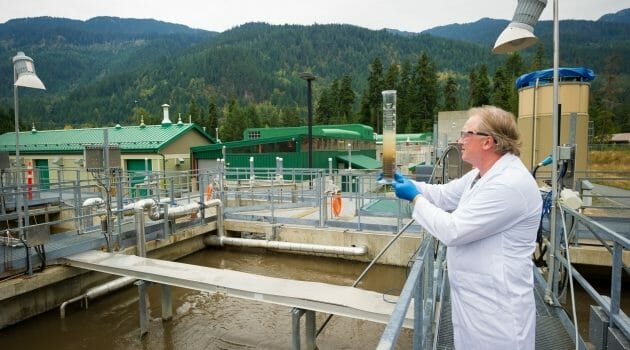
Household and commercial wastewater for the most part enters a piped collection system. The collection system extends from Emerald Estates in the north to Function Junction in the south. Collected wastewater flows by gravity to a series of pump stations that pump the water into the trunk sewer that delivers the wastewater to the treatment plant site, located south of Highway 99, near Function Junction. Once treated by the biological nutrient removal process, the wastewater is discharged to the Cheakamus River via a river bank outfall.