
Water safety
Taking simple steps can make all the difference in keeping Whistler’s water resources safe places for everyone to play.
- Use appropriate equipment. Inflatable boats and other water toys easily deflate and capsize and are not suitable for floating on the River of Golden Dreams.
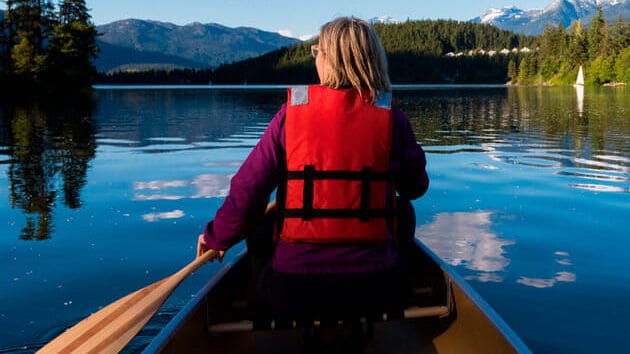
- Wear a lifejacket or personal flotation device (PFD). According to federal law, you must have a Canadian approved lifejacket or PFD while in a boat, inner tube, paddle board, raft or other flotation device. The maximum fine for violation is $500.
- Do not mix water activities and alcohol. Whistler’s rivers, lakes and beaches are public places, and the consumption of alcohol beverages is prohibited. Alcohol increases the risk of hypothermia, increases fatigue, impairs decision-making and slows reaction time.
- Know the signs of drowning. Drowning does not typically involve screaming and waving hands, unlike the way it is often portrayed in the movies. In fact it can often be completely silent.
- Do not litter. Please properly dispose of inflatable boats and water toys that have deflated, along with any garbage and recycling such as bottles and cans, in the appropriate bins.
- Obey all rules and posted signs. Whistler’s lakes, beaches and the River of Golden Dreams are not monitored by lifeguards. Be prepared for self-rescue, and never travel alone.
- Reduce the potential of swimmer’s itch. Wear waterproof sunscreen, avoid areas with lots of weed growth, and towel off vigorously or shower immediately after leaving the water. Learn more about swimmer’s itch and beach water quality monitoring.
- Watch out for boats on Green Lake and Alta Lake. Motor boating is only permitted on Green Lake and Alta Lake with speed restrictions.
Swimmer’s itch
If swimmer’s Itch is reported, signage is posted and users are encouraged to shower immediately after swimming and/or immediately dry with a clean towel.
Swimmer’s itch naturally occurs throughout North America and is a temporary, itchy rash caused by microscopic parasites passed between water fowl and certain snails.
A larval parasite, called a cercaria, is released by snails and can mistakenly penetrate a person’s skin rather than its rightful host, usually a duck. Swimmer’s itch occurs in both freshwater and marine coastal environments and is not related to the quality of the water.
While there is no formal monitoring program for swimmer’s itch at Whistler’s beaches, if the RMOW receives a report from a community member or the Whistler Health Care Centre, signs are posted at the swimming beach with information about how to reduce the risk.
Learn more about swimmer’s itch by reading an overview from HealthLink BC.
River of Golden Dreams
Inflatable boats and other water toys easily deflate and capsize and are not suitable for floating on the River of Golden Dreams. Take simple steps to prepare, like using proper equipment, obeying posted signs, avoiding alcohol and knowing the signs of drowning. Be prepared for self-rescue, and never travel alone.