What’s next for the Balance Model?
The Whistler Balance Model was created to help the community understand what future growth could look like within the development limits set by the Official Community Plan (OCP) bed unit cap.
A Strategic Planning Committee helped create the model to explore how increasing numbers of residents, workers, visitors, and housing could affect Whistler over the long term. The findings helped inform our planning and decision-making from 2019 to fall 2022. When the Balance Model was released, we planned a future update to examine these growth scenarios in more detail.
But a lot changed after 2022. The Province of B.C. released legislation changes in 2023 to increase housing supply. This made some of the original growth estimates less certain. We also moved from focusing on forecasting growth, to understanding how people use the community and its infrastructure.
Through Smart Tourism, we look at understanding and managing visitor behaviour, travel patterns, and seasonal demand. These impacts are affected not only by how many people are here, but also by when, where, and how they visit.
Although a formal public update to the Balance Model was not completed, this work continues to influence how we plan. The insights we learned through the model are included in our ongoing planning and operational work. This helps us prepare for future housing, workforce, infrastructure, and service needs over the next 20 years.
Today, conversations about capacity and growth continue through Smart Tourism and how we care for Whistler as a destination. This approach builds on questions explored with the Balance Model. We also know community wellbeing, visitor experience, environmental health, and economic vitality are all connected and have to be considered together.
Community Planning and the Balance Model initiative
This initiative sought to understand changing trends in Whistler’s population — and study the capacity of services and amenities to support that population. The intent was to consider the implications of growth in the context of progress towards the achievement of Whistler’s vision – including implications for social, environmental and economic performance.
Based on historical analysis of relationships between population changes and community performance over the past 20 years, a model was developed to project and test a range of scenarios that might occur over the next 20 years. This enabled us to consider implications of shifting trends in population, and establish strategies and actions to work towards achieving goals for and with the community.
The Balance Model considered all population segments, from permanent residents to temporary residents, both owners and renters, resort workforce and non-workforce, as well as visitors – regional and destination and both overnight and day.
This initiative was being progressed with input from a Strategic Planning Committee: a standing Committee of Council that was initiated in 2019 to act in an advisory capacity to support Council in its decision-making related to community and land use planning and growth management.
Timeline and process
There were three key phases being undertaken in this community planning work:
- Current State Assessment
- Future Population Scenario Testing
- Strategies and Actions
Phases 1 and 2 (the Current State Assessment and Future Population Scenario Testing) were completed in 2022 and shared with council and the public.
Read the Phase 1 Report to Committee of the Whole (PDF), or watch the live presentation
Read the Phase 2 Report to Committee of the Whole (PDF), or watch the live presentation
Read the Interim Summary Report to Council, or watch the line presentation
What did we learn?
The Balance Model process identified three foundational implications fundamental to the community’s success and well-being, and critical to resolve in order to have meaningful impact on reaching our vision in the OCP.
The Foundational Implications are Housing, Transportation, and Demand Management.
Housing
- Community: Affordability challenges for residents, potential loss of community.
- Economy: Workforce shortages impacting businesses (without efficiencies).
- Environment: Increased commuters impacting GHG emissions.
Transportation
- Community: Congestion within Whistler impacting livability.
- Economy: Congestion impacting visitor experience.
- Environment: Single-occupancy vehicle use impacting GHG emissions.
Demand management
- Community: Increasing commercial rates impacting viability for resident-orientated businesses and services.
- Economy: Visitation to drive up labour needs, increasing cost of business may impact business viability sustaining Whistler’s differentiation and uniqueness.
- Environment: Increasing GHG emissions from vehicles, degradation of parks, trails and biodiversity.
Housing
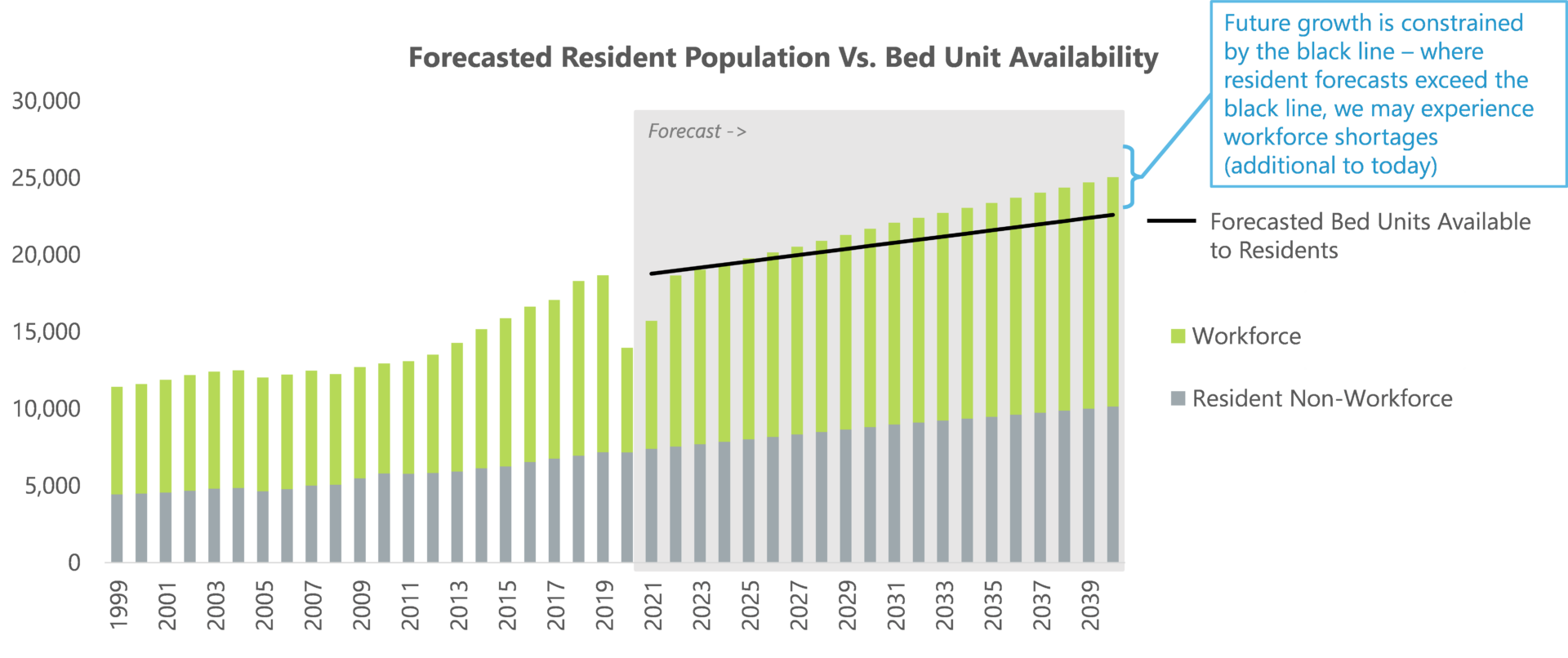
The current housing challenges will continue to worsen, as demand for employees continues to outpace additional supply of employee restricted housing, leading to inevitable further workforce shortages.
The chart below depicts the future Growth of Year-round residents (particularly workforce members) that continues to be constrained by the availability of housing, resulting in further workforce shortages.
Transportation
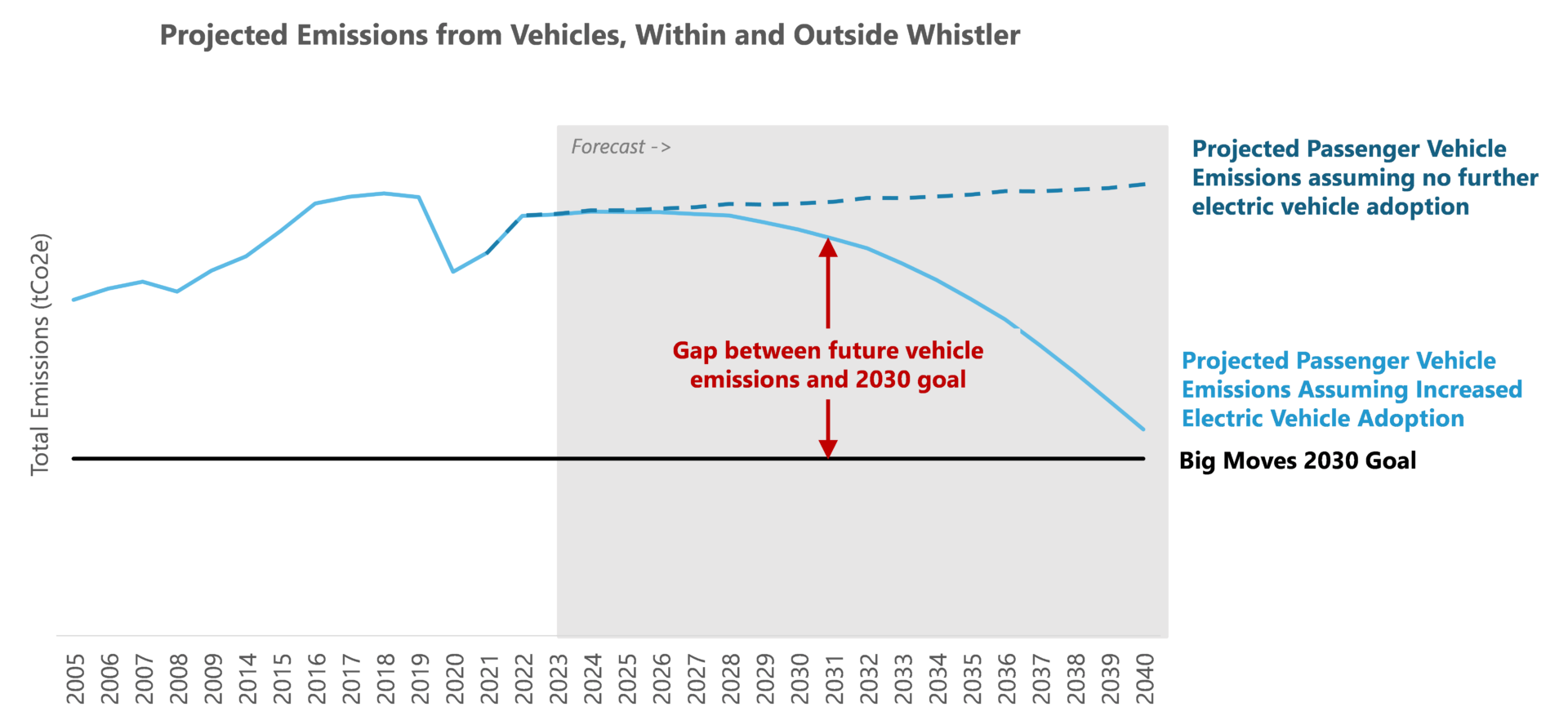
Transportation congestion and related GHG emissions have worsened during COVID, and will continue to challenge the community – exceeding the capacity of the highway and village roads resulting in longer congestion and travel times, while also neglecting to meet GHG emission targets, and impacting both resident and visitor experiences.
The chart below shows the impact of future increases in population and visitation that leads to increasing traffic on the highway – pushing us well beyond our 2030 Big Moves climate goals even as we consider the transition to electric vehicles.
Demand management
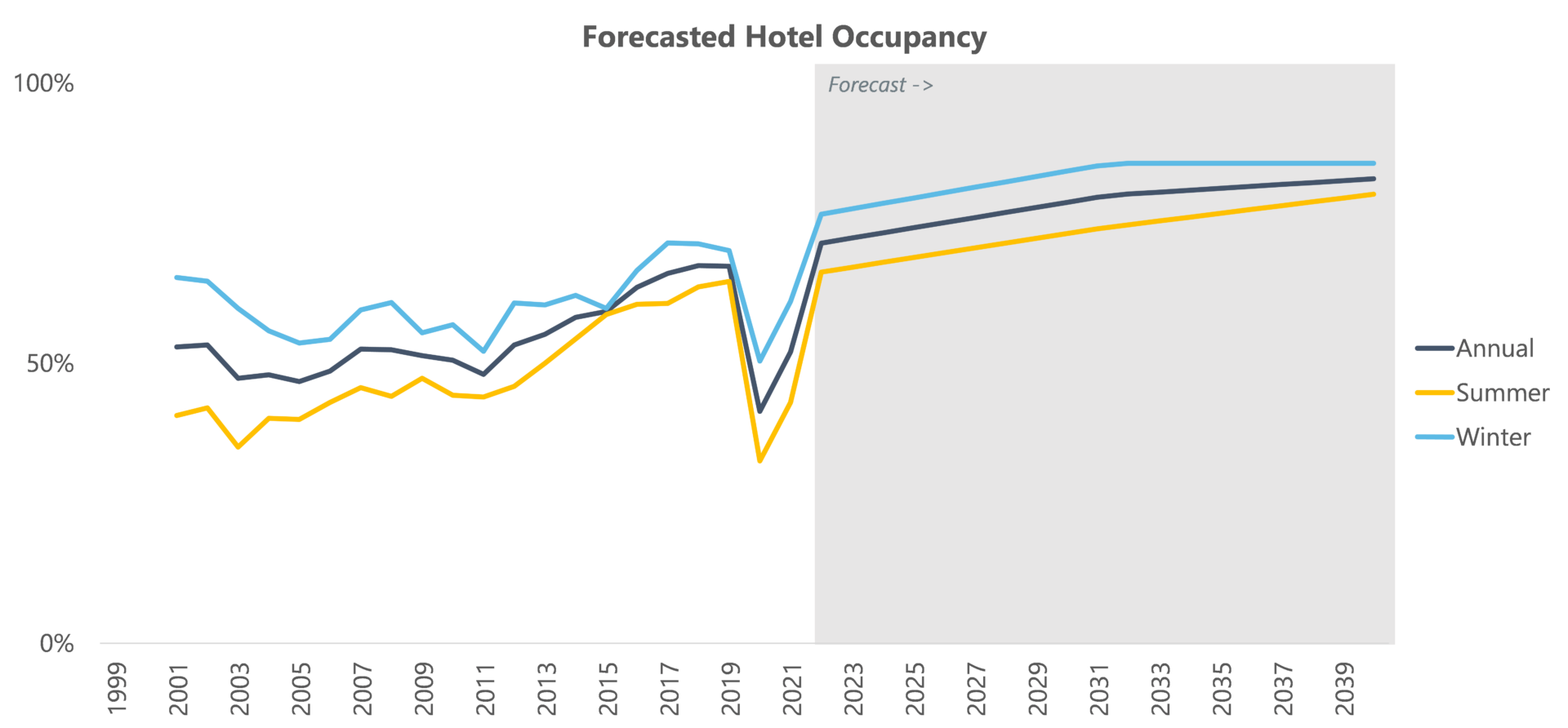
Demand Management is needed as visitation will continue to increase from external forces outside of RMOW control to fill the existing built capacity, until current “peak” visitation levels become the average. Increasing visitation levels will also drive up the need for workforce –further exacerbating the current housing and transportation related challenges as described above.
The chart below shows hotel occupancy levels continuing to increase up to maximum operational capacity. Based on strong forecasts for regional population growth and YVR’s expansion plan, tourism in BC is not likely to slow down – and while visitation levels are currently strong, there is room for this to grow further.
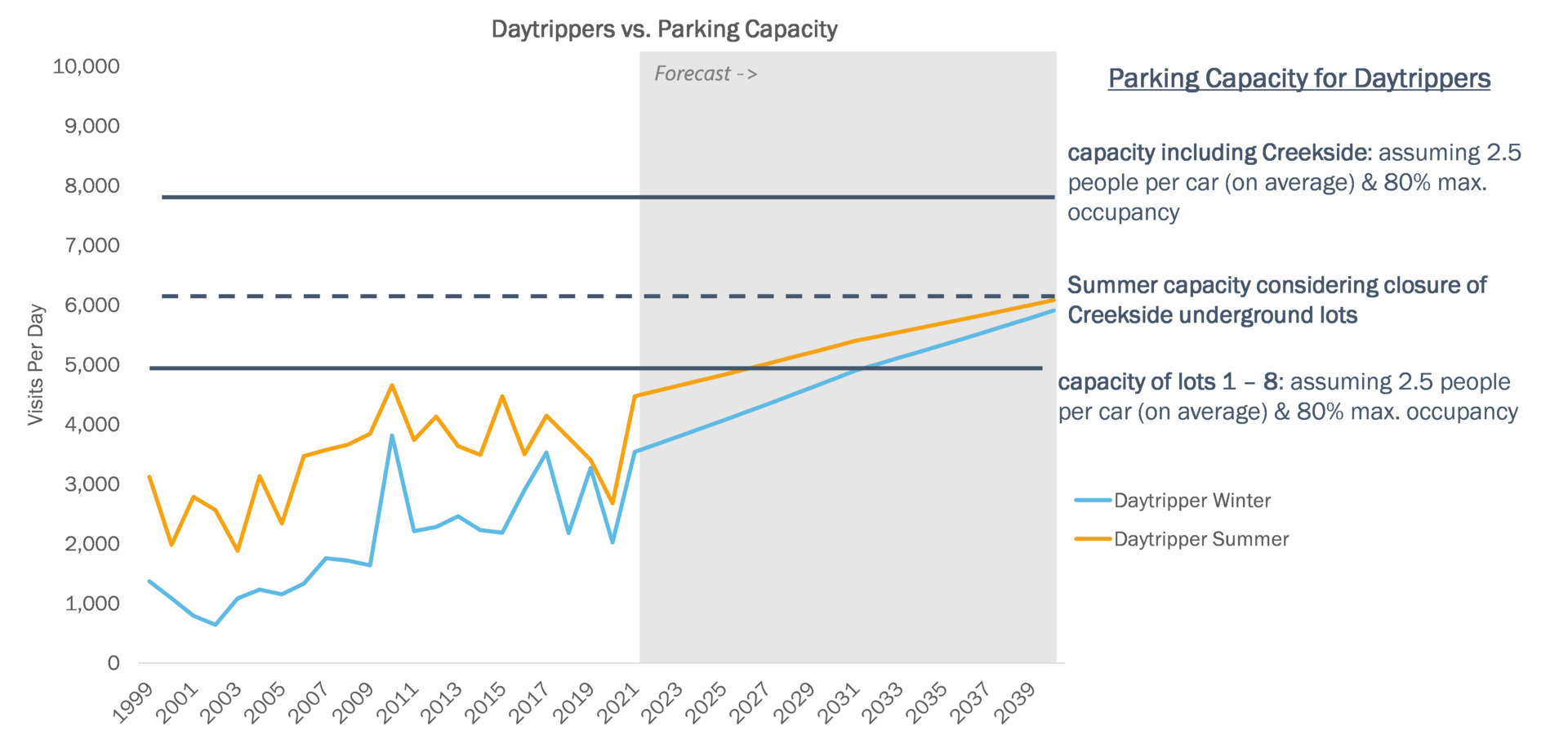
The chart below shows potential for increased day visitation within parking lot capacity as Whistler continues to be a popular destination year-round.
What was the Balance Model?
The Balance Model was a modelling tool for Community planning, ongoing analysis, and evaluation of progress against the goals we have set out in the Official Community Plan. It was a management tool to help inform decision making, but didn’t provide strategies, actions or solutions. It provided data and analysis to support staff with their work, and Council in their decision making.
What did the Balance Model do?
- Provided segmented estimates of Whistler’s current daily population levels and historical trends including both residents and visitors.
- Tested potential scenarios of Whistler’s future daily population levels, including both residents and visitors.
- Examined the relationship between population and indicators of community, economic, and environmental performance.
- Identified implications, tradeoffs, and pain points between community, environment, and economic goals.
- Predicted future potential performance of indicators of community, economic, and environmental performance given possible future population scenarios.
- Provided key insights to enable strategic discussion with community stakeholders on future potential implications and proactive management.
How did the Balance Model work?
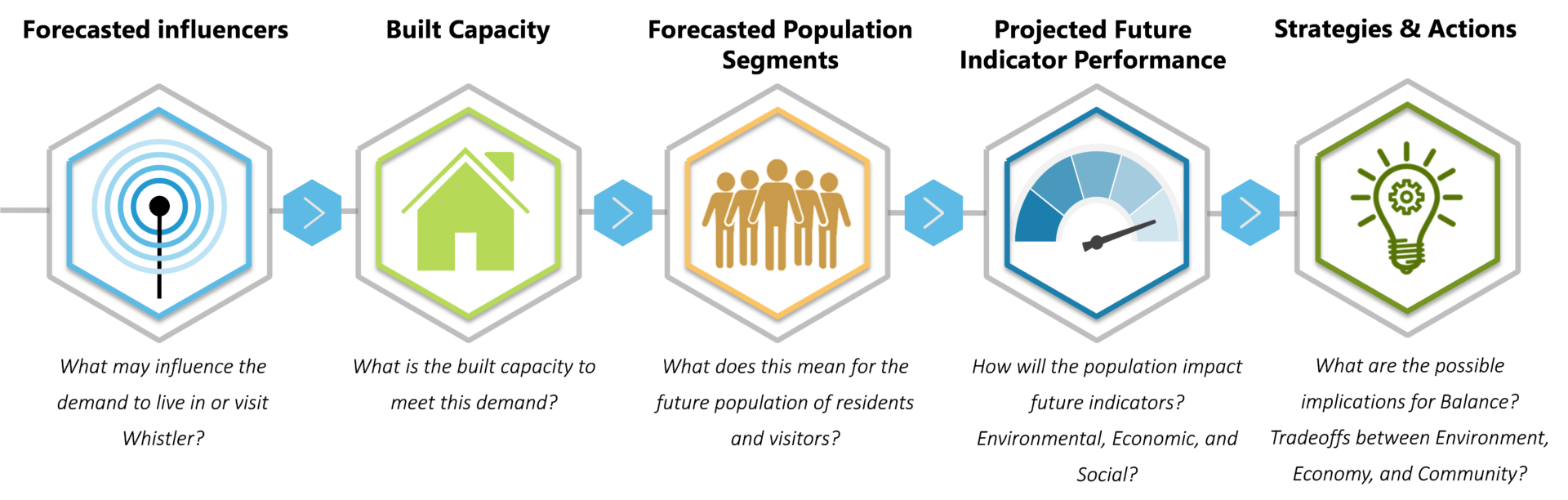
Forecasted Influencers
The balance model forecasted the future population based on potential growth “influencers”. For example, the Lower Mainland population influences visitation from the region, so the expected future Lower Mainland population was used to inform forecasts for Whistler’s visitation levels.
Built Capacity
Future scenarios of built capacity (e.g. tourist accommodation, parking, residential housing) were layered over population forecasts to reflect Whistler’s ability to accommodate future growth.
Forecasted Population Segments
Constrained population projections were developed by combining the above two steps. Projections will be formed at the segment level (e.g. workforce, residents, visitors, etc.).
Projected Future Indicator Performance
A range of community, economic, and environmental indicators were projected 20 years into the future for each of the population scenarios.
Strategies and Actions
The future performance of community, economic, and environmental indicators in various population scenarios were used to foster important engagement with community partners as to future strategies and actions.