
Looking to get caught up on the latest from Council? We’ve pulled together some key stories from the January 20 and February 4 Regular Council meetings, including:
- Whistler Housing Authority to assume employee verification from RMOW
- Council adopts two policies aimed at recognizing Whistlerites’ achievements
- First readings of new Public Outdoor Space Regulation bylaw
- Council adds public hearing to Waldorf rezoning process
For all the details, find council reports and video recordings of the full meetings at whistler.ca.
Whistler Housing Authority to assume employee housing verification
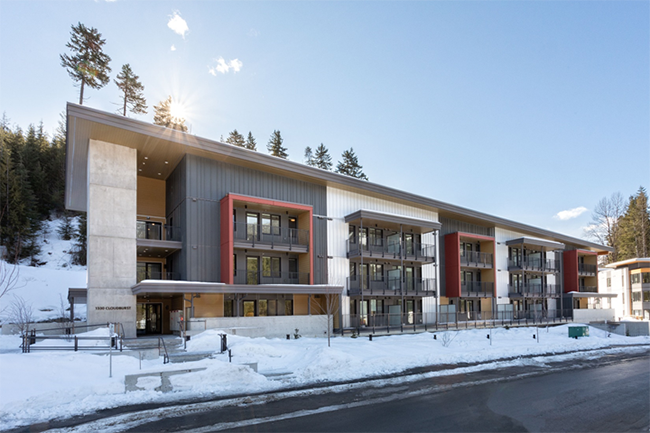
The Whistler Housing Authority (WHA) will take over the process of verifying who lives in employee restricted affordable housing across the resort’s growing inventory, as described in a new Master Services Agreement with the RMOW that was presented at the February 3 Council meeting.
“The goal is to make this as easy as possible, but ultimately we’re trying to ensure that we have the appropriate oversight over our extensive employee housing inventory,” explained Pauline Lysaght, corporate officer and manager of Legislative Services.
Under the agreement, the WHA, a municipal subsidiary, will be contracted to administer the eligibility and statutory declaration requirements for all existing and future employee-restricted housing in Whistler.
This will include the increasing number of employee housing units not owned by the WHA, including units owned by the Whistler Valley Housing Society, Whistler Sport Legacies, market housing with employee suites, and small-scale multi-unit housing units owned by the private sector. The RMOW’s Legislative Services Department had been managing this growing housing category internally until a formal agreement could be finalized.
Employees are required to work a certain number of hours per week for a Whistler business to be eligible for restricted employee housing. The annual audit process is completed to confirm employees’ eligibility and maintain their tenancy. The WHA also manages the yearly statutory declaration required for owners of employee housing, which is similar to the process for WHA rental units.
For rental units not owned by the WHA, the owner must only rent to tenants who meet the eligibility requirements set out in their property’s housing agreement. Under the new Master Services Agreement, those selected tenants will upload their proof of eligibility through the WHA online portal. Once confirmed, the owner and tenant can sign a tenancy agreement.
Whistler boasts one of the highest numbers of employee housing units per capita in Canada. With a target of housing 75 per cent of employees locally, the WHA owns 375 rental homes and manages 1,001 for-purchase homes, with an additional 232 rental units under construction in Cheakamus Crossing.
Read the full report here.
Council codifies new Freedom of the Municipality, athlete recognition policies

On February 3, Council endorsed two distinct policies aimed at recognizing the achievements of Whistler residents.
Council Policy A-42 governs the awarding of the highest civic honour the RMOW can bestow, the Freedom of the Municipality, while the other formalizes how to celebrate Whistler athletes that represent Canada on the global stage.
The formalized Freedom of the Municipality policy preserves Council’s discretion in awarding the honour, while providing a structured framework for considering nominations and how to formally celebrate the new recipients.
The Freedom of the Municipality honours Whistlerites for their outstanding contributions to the community, and grants recipients the right to vote in local elections regardless of property ownership or residency in Whistler. A total of 21 individuals have received the honour over the years.
Read the full report here.
In time for the 2026 Winter Olympics and Paralympics, Council on February 3 endorsed Policy A-43, which establishes a clear and consistent process for recognizing athletes with strong Whistler connections who have represented Canada in international athletic competition.
Over the years, Council has acknowledged local athletes in various ways, but these approaches have varied, with no consistent framework in place.
The policy includes two categories of recognition: one for athletes who have medalled while representing Canada at major international events such as the Olympics, Paralympics, and world championships, and one for athletes who have qualified to represent Canada at major international events but have not reached the podium.
Recognition will be integrated into existing municipal events, allowing formats to evolve, and respecting athletes’ preferences regarding and how and where they are recognized.
Read the full report here.
Council gives first readings to new Public Outdoor Space Regulation Bylaw

At the January 20 Regular meeting, Council gave first three readings to a new bylaw that regulates the use of outdoor space in Whistler.
The new bylaw, which will replace the Park Use Bylaw first adopted in 2002, aims to improve the RMOW’s protection of safe and respectful outdoor places and experiences. It expands in scope to consider all public outdoor spaces, not just parks, and includes guidance for a growing variety of personal mobility devices including cycles, e-bikes and prohibited e-devices. It also regulates drones, water vessels, motor vehicles, smoking and commercial activities.
Aiming to balance speed and safety concerns with enforcement practicalities and the evolving e-mobility landscape, the bylaw proposes:
- aligning with the regulations set out in B.C.’s Motor Vehicle Act, which prohibits motor-assisted cycles that provide power above 32 kilometres an hour;
- allowing throttle bikes that align with the Motor Vehicle Act on municipal roads, Forest Service Roads, Highway 99 and the Valley Trail, reflecting local user patterns, but prohibiting them from trails in nature and other pedestrian-only trails;
- ensuring e-bikes without a throttle are also permitted on municipal roads, Forest Service Roads, Highway 99 and the Valley Trail, as well as on select recreational trails. They would be prohibited from pedestrian-only and nature trails, as well as recreational trails where e-bikes are currently prohibited by signage on Sproatt and Rainbow mountains, as well as some trails in the Emerald Forest.
The bylaw does not allow less common e-mobility devices in public outdoor spaces, including e-bikes and e-motorcycles that do not meet the definition of a motor-assisted cycle in the Motor Vehicle Act, e-skateboards and e-scooters.
Rather than introducing a speed limit on the Valley Trail, the proposed bylaw focuses on user behaviour, with fines up to $500 for users that operate a mobility device at a speed that endangers others, is unsafe for the conditions or unreasonably interferes with others’ enjoyment. Serious violations would be pursued in court and could result in fines of up to $50,000 and three months imprisonment.
A speed limit is not recommended in the bylaw for a variety of reasons, including:
- the impracticality of enforcing more than 50 km of trails;
- the general lack of speedometers installed on e-bikes;
- some members of the public’s refusal to provide bylaw officers with the identification required for enforcement.
Municipal staff are not aware of a single jurisdiction in North America that has effectively implemented and enforced speed limits on comparable trails.
The RMOW has paired the proposed bylaw with more than 230 safety signs along the Valley Trail and a public campaign meant to reinforce proper trail etiquette. The RMOW will also consider joint enforcement with the local RCMP.
Read the full report here.
Council adds public hearing to Waldorf rezoning process

Council recommended adding a public hearing to the proposed rezoning of Lot 34 on Alta Lake Road that could serve as the new home of the Whistler Waldorf School and daycare.
At the Tuesday, January 20 Regular meeting, Council gave first and second readings to the proposal, opting to delay third reading in favour of hosting a public hearing to give residents the formal opportunity to provide input. The public hearing was held online on Tuesday, February 10.
Under B.C.’s Local Government Act, Council was not required to host a public hearing, as the proposed school and daycare use aligns with Whistler’s Official Community Plan. Council voted to add a public hearing to the process after hearing from residents who wanted to comment on the proposal’s potential impacts.
“The public hearing is at the discretion of Council,” said Councillor Ralph Forsyth. “In this case, I feel like having the option and exercising the option of having the public hearing is still the cleanest, most user-friendly, expedited way to get Waldorf to its future home.”
If approved, the rezoning would add school and institutional to the permitted uses at the 0.75-hectare site between Alta Lake Road, Old Mill Lane and Alta Lake. There are several approval criteria attached to the rezoning, including a new development covenant that requires a completed traffic impact study, traffic management plan, and a Green Building Policy checklist. The covenant would also cap the maximum number of school students at 275 and the number of licensed childcare spaces at 25.
Whistler Waldorf School has been seeking a permanent home since the B.C. government denied a request last year to extend the school’s temporary lease in Spruce Grove Park after the province determined a school was inconsistent with the Crown grant lease. The school is permitted to operate at its current site until June 2026.
More than 30 local sites were assessed, with Lot 34, to be donated by a private landowner, determined to be the most suitable to host the school and auxiliary daycare. At Council’s direction, the RMOW initiated the zoning amendment to expedite the transition to a new school site ahead of the 2026-27 academic year.
Read the report in full here.
To attend an upcoming meeting, check out the Council meeting Schedule. Agendas and Minutes are available online. To connect with Council, consider Borrowing a Councillor from the Library’s Unusual Items Collection, or get in touch with them individually by phone or email.