
Looking to get caught up on the latest from Council? We’ve pulled together some key stories from the September 16, 2025 Regular Council and Committee of the Whole meetings, including:
- The proposed Works and Services Bylaw update
- The Municipal Land Inventory for Residential Suitability Report
For all the details, find council reports and video recordings of the full meetings at whistler.ca.
Works and Services Bylaw update would ensure new development contributes financially to Whistler’s future
Municipal staff have proposed changes to Whistler’s Works and Services (W&S) Bylaw that would ensure new developments contribute equitably to the community’s future capital costs.
Works and Services charges are a municipal fee designed to ensure new development financially contributes to the costs of municipal services and infrastructure required to support that new development in the future.
The updated bylaw will ensure the costs of new infrastructure are shared fairly, protecting existing taxpayers from undue financial burden.
At the September 16 Committee of the Whole meeting, Council heard the latest on staff’s work to update and modernize our Works and Services charges bylaw framework, which would apply to new residential, commercial and industrial developments. There are several key changes proposed to the bylaw, including:
- Consolidating five existing W&S charge bylaws into one, lending to a more streamlined, simplified process.
- Adding new W&S charges that would be applied to future parks and transit costs in the community, something that hasn’t historically been done in Whistler.
- Changing how W&S charges are calculated, based on the size of the proposed development, rather than at a fixed rate per parcel. Size-based fees are standard in most municipalities for commercial and industrial developments, but less so for residential properties, although it is becoming more common in other communities. Staff believe there is strong rationale for larger development projects, residential included, to contribute more to Whistler’s growth-related costs. The proposed fee structure changes are in line with similar costs in comparable communities.
- The new approach proposes employee housing W&S charges for all new construction types (except new covenanted affordable employee housing projects). Historically, employee housing charges were only levied on new commercial and industrial development, not residential. However, we know all new construction creates the need for new employees locally, therefore staff feel all new construction should contribute towards Whistler’s Employee Housing Reserve and the development of new affordable employee housing supply.
- Providing more clarity on how charges apply to redevelopment and/or densification of existing properties. For instance, in the draft bylaw, charges would generally only apply for renovations that expand a building’s total floor area.
Along with supporting infrastructure costs related to Whistler’s forecasted growth of 3,700 anticipated new dwelling units in the next 20 years, updating the W&S bylaw is intended to align with new provincial legislation, Bill 44 and Bill 46, aimed at increasing housing density and addressing B.C.’s housing shortage. The update also fulfills commitments associated with a $2.5-million grant Whistler is earmarked to receive through the Canada Mortgage Housing Corporation’s Housing Accelerator Fund.
If approved, the updated bylaw is anticipated to take effect in either Q3 or Q4 of 2026 and include instream protections for permits currently in process. The community can add their voice to the proposed Works and Services bylaw update online here. Survey findings and related project input will be presented at the November 4 Council meeting.
View the full report here.
Municipal Land Inventory Report analyzes Whistler’s land parcels for future residential development
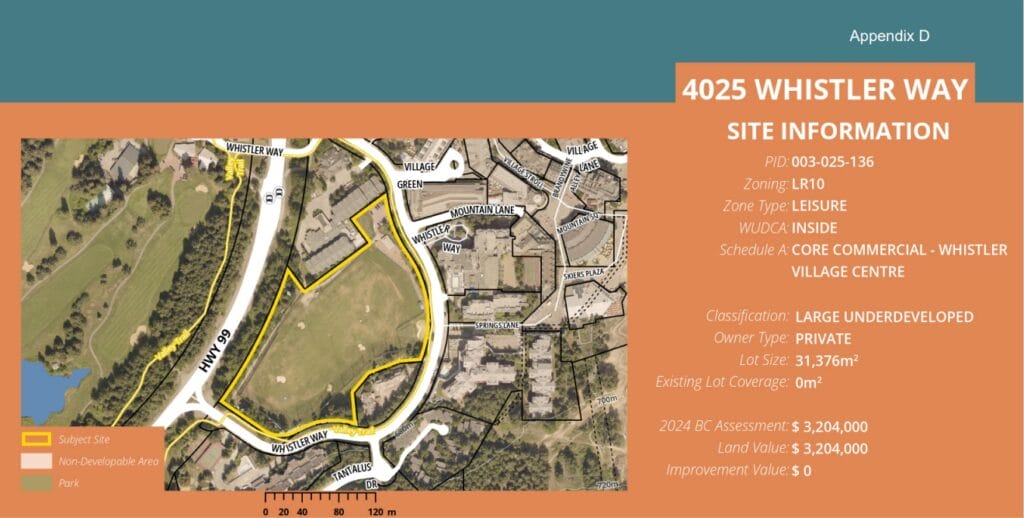
A new report takes stock of municipal land parcels across Whistler and assesses them for their development potential.
The Municipal Land Inventory for Residential Suitability Report, presented at the September 16 Regular Council meeting, takes a comprehensive look at publicly owned land within and outside of the Whistler Urban Development Containment Area, evaluating parcels for their suitability for residential development.
The report identified 122 municipally owned parcels, breaking them into three categories:
- Undeveloped: Vacant land with no existing building footprint.
- Underdeveloped: Land with existing structures and buildings covering less than 10 per cent of the lot area.
- Infill and Subdivision Potential: Land that meets minimum frontage and zoning area requirements, making them suitable for infill development or subdivision.
Parcels were evaluated based on a broad range of criteria, including a site’s characteristics and land-use compliance; environmental and topographical constraints; infrastructure and site serviceability; and road access and emergency services.
In all, six parcels were scored as having high development potential, 64 with medium development potential, and 52 with low development potential.
The inventory encompasses all municipally owned parcels, many of which are not currently designated for residential use and include well-established parks or essential community amenities. This work is only intended as a true inventory of lands and does not guarantee or impose any development rights. As such, all lands under municipal control were assessed under the same criteria.
This ongoing work will support long-term planning, such as the forthcoming Municipal Land Strategy and Official Community Plan update, that balances housing objectives with environmental protection, community use and infrastructure considerations. In particular, the Municipal Land Strategy will begin to use the Inventory data and add other considerations to the parcel review that will shape the direction of residential growth in Whistler.
“I’m so excited about what is in front of us today because it gives us really valuable information and I am equally excited about seeing the Municipal Land Strategy in front of us, which will give us information we need on where to go to next,” said Mayor Jack Crompton.
View the full report here.
To attend an upcoming meeting, check out the Council meeting Schedule. Agendas and Minutes are available online. To connect with Council, consider Borrowing a Councillor from the Library’s Unusual Items Collection, or get in touch with them individually by phone or email.