Looking to get caught up on the latest from Council? We’ve pulled together some key stories from the May 13, 2025 Regular Council and Committee of the Whole meetings, including:
- Draft land-use concept for Whistler Creek West
- Community Wildfire Resiliency Plan progress update
- Bylaw amendment restricts high-risk construction activity when fire danger rating reaches High or Extreme
For all the details, find council reports and video recordings of the full meetings at whistler.ca.
Staff unveil draft land-use concept for Whistler Creek West
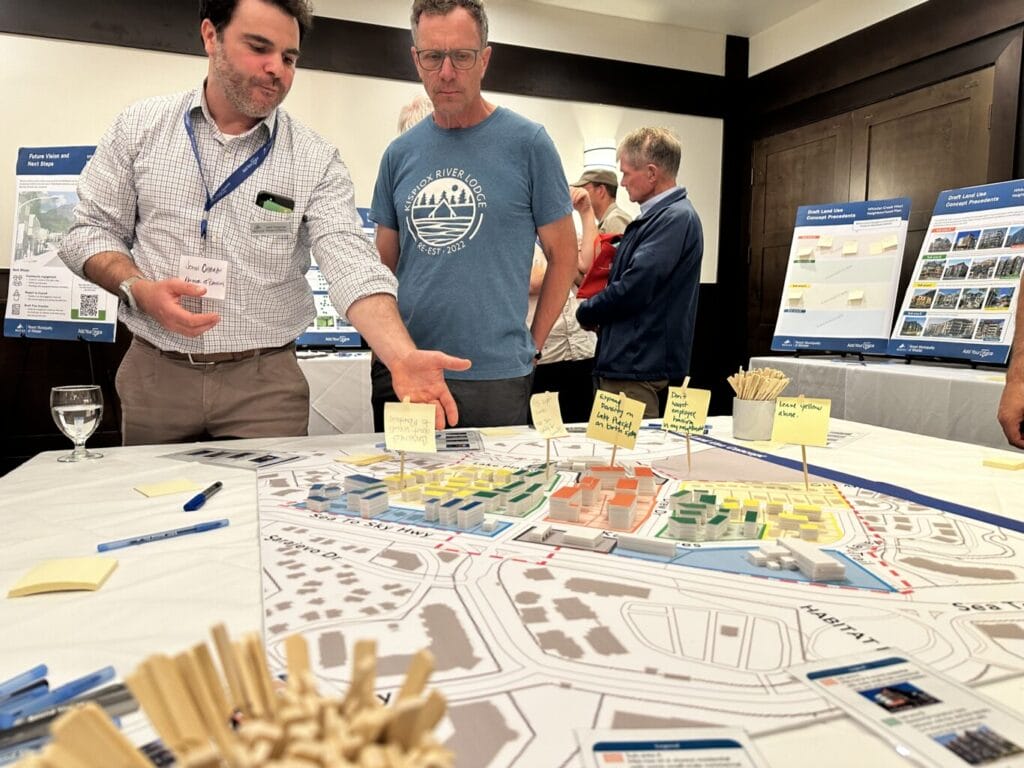
At the May 13 Committee of the Whole meeting, municipal staff presented the latest draft land-use concept for Whistler Creek West, based on community input from the first phase of engagement on the neighbourhood plan.
Staff proposed four sub-areas in the plan, each with different densities and development form, supporting a greater diversity of housing in the neighbourhood.
It’s important to note the following proposals are intended for discussion purposes and to demonstrate different examples of density and housing type for each sub-area.
- Sub-area A: Stretching from the Co-op service station west to Nita Lake Lodge along the north side of Lake Placid Road, this sub-area proposes mid-rise (4-6 storey) development. The intention is to maximize employee-restricted housing, while continuing with the existing commercial uses in the area.
- Sub-area B: Encompassing the south side of Lake Placid Road and Drew Drive, this sub-area is a residential, transitional zone between Sub-areas A and D and the lower density Sub-area C. A 3-4 storey development, with ground-level orientation, is proposed for this sub-area.
- Sub-area C: Stretching from the edge of Alpha Lake Park, Sub-area C is proposed to have the lowest density of all four sub-areas. Given its proximity to future frequent transit service, staff have proposed a base density of six units per lot in this sub-area to align with provincial Bill 44. While high-frequency bus service is not yet established in Whistler, the entire plan falls within the 400-metre radius of bus stops that are likely to meet this service soon. When that threshold is met, Bill 44 will require a base zoning allowing for six units per parcel.
- Sub-area D: Located between Karen Crescent and Highway 99, Sub-Area D is proposed as a transition zone from the overall neighbourhood plan area to Highway 99. This sub-area would allow for three- to five-storey residential development.
Next steps
The community will have several opportunities for input on the proposed land-use concept, implementation strategies, and preferences for the neighbourhood’s streetscape, public area designs, and building forms.
- Online survey: June 3 to July 6.
- In-person engagement that took place at the Add Your Voice Engagement Forum on June 4 and a public open house on June 7.
The proposed plan will be presented to the RMOW’s the Advisory Design Panel on June 18 and the Housing and Strategy Committee on July 14 for input.
After the engagement phase, staff will present the results to Council before returning with a draft plan and bylaw amendments for consideration.
Read the report here.
How we’ve improved Whistler’s wildfire resilience

At the May 13 Regular Council meeting, staff provided an update on the progress made on building Whistler’s wildfire resilience, as well as detailing upcoming mitigation plans.
Wildfires remain the greatest climate change-related risk to Whistler, making wildfire resilience a top priority. Since the RMOW’s first Community Wildfire Protection Plan in 2005, we have continuously advanced our wildfire mitigation efforts, culminating in 2022’s Community Wildfire Resiliency Plan (PDF) and last year’s Community Wildfire Defence Plan (PDF), a major step forward in emergency planning and coordination.
Fuel thinning
Strategic fuel thinning, also known as vegetation management, aims to reduce wildfire risk and severity while enhancing the resilience of Whistler’s surrounding forests. In 2024, fuel thinning progress included:
- Emerald West: Treating an area of nine hectares to the west of the Emerald neighborhood;
- Brio and Brio Extension: Treated an area of 18 hectares north of the Brio neighborhood. This work was done in collaboration with B.C.’s Mountain Resorts Branch and Vail Resorts.
Fuel thinning planned for 2025 includes:
- Highway 99: This project will be implemented by multiple teams, including the Whistler FireSmart Program team, Líl ̓wat Forestry Ventures, and Alpine Axeleration;
- Stonebridge and the Whistler Cemetery;
- Alta Lake Road North;
- 16 Mile fuel break: A multi-year project with planning set to begin in 2025.
Monitoring
Active since 2023, Whistler’s Fuel Thinning Monitoring Program was developed to understand the impacts of fuel thinning treatments on wildfire risk and forest ecology across Whistler’s diverse forest types.
Detailed sampling has been conducted in six representative treatment areas, including Lost Lake, Callaghan, and Taluswood. Fire behaviour modelling consistently demonstrated reduced flame length, rate of spread, and wildfire intensity in thinned plots across all study areas, despite thinned stands tending to be slightly drier and warmer than unthinned stands. This reinforces the effectiveness of Whistler’s fuel thinning efforts in reducing wildfire risk.
Plans are underway to expand the monitoring program to include additional sites and treatment types, bolstering the program’s future analysis.
Wildfire Defence Plan
Notable achievements in 2024 include:
- BC Wildfire adopted Whistler’s plans into their Structure Protection program.
- Basic wildfire training: 47 participants representing the RMOW, Whistler Blackcomb and the Squamish Nation were trained last year;
- Eight Whistler Fire Rescue Service members attended the November 2024 BC Wildfire Engine Boss Training in Squamish;
- Four Whistler Fire Rescue Service members attended the March 2024 BC Wildfire Task Force Team Leader Training in Maple Ridge.
New for 2025:
- Wildland truck donated to the Whistler Fire Rescue Service, thanks to funding from the Whistler Blackcomb Foundation;
- Collaborating with the National Indigenous Safety Council on additional basic wildfire training for the Squamish Nation, the Líl ̓wat Nation, RMOW and Whistler Blackcomb;
- 24 Paid on Call WFRS members completed their Wildland Firefighter Level 1 training in April;
- 24 Paid on Call WFRS members completed their Structure Protection Unit training in April;
- Cross-training exercise between the Whistler Fire Rescue Service, Whistler Blackcomb, BC Wildfire and RMOW staff completed in May.
Emergency planning
Notable achievements for 2024 include:
- Representatives from the RMOW, Whistler Fire Rescue Service and RCMP conducted an emergency wildfire evacuation drill in designated areas of the Spring Creek neighbourhood;
- Provided in-house course for evacuations, for RMOW and other regional emergency management staff;
- More than 30 RMOW staff received Emergency Operations Centre (EOC) Essentials and other EOC training online.
New for 2025:
- Started work with Provincial Emergency Management and Climate Resiliency staff to improve their all-hazards plan;
- Provided an Emergency Operations Centre refresher workshop to RMOW management.
FireSmart
FireSmart homes and neighbourhoods are more resistant to ignition and help prevent structure-to-structure fires.
Notable achievements for 2024 include:
- 24 FireSmart workdays with neighbourhoods representing participation of approximately 250 homeowners and residents;
- 352 distinct properties utilized the FireSmart Community Chipper Service;
- Six public engagement events delivered to approximately 70 people;
- 125 Home Partners Program assessments and two certified properties;
- Six neighbourhood assessments;
- 61 critical infrastructure assessments with 50 per cent landscapes treated by the crew;
- 2.3 hectares of municipal forest treated;
- 380 metric tonnes of fire fuel removed;
- Onboarded two local garden centres into the FireSmartBC plant program.
Read the report here.
Bylaw amendment restricts high-risk construction activity during High and Extreme fire ratings
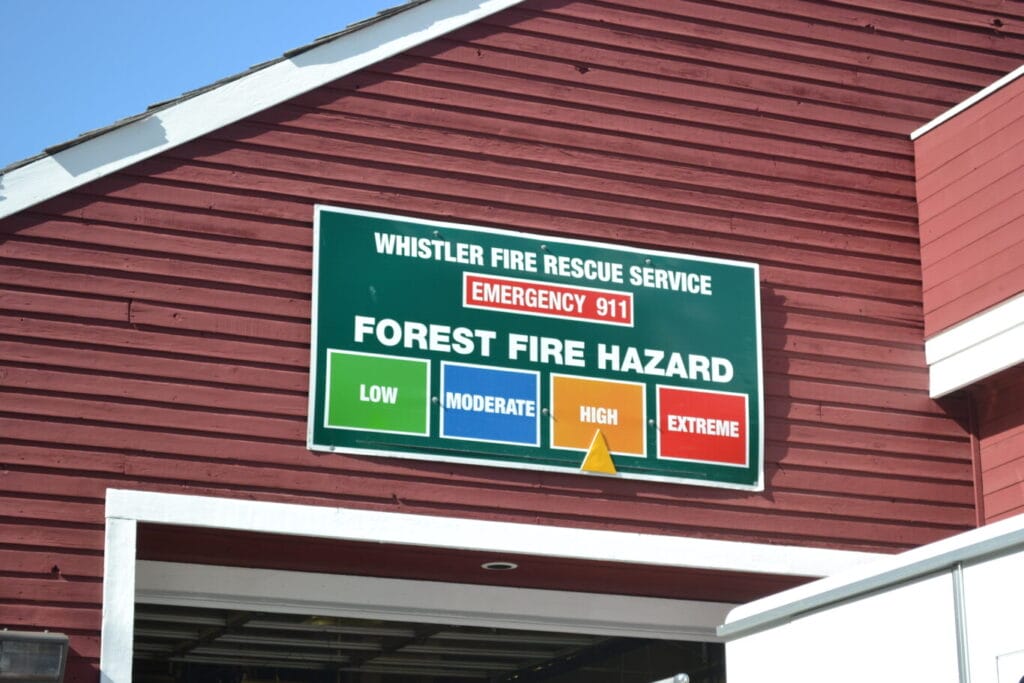
On May 13, Council gave first three readings to a newly amended bylaw aimed at mitigating wildfire risk on construction and landscaping sites during high and extreme fire danger ratings.
Climate change has made fire season in Whistler hotter, drier and longer. Historically, wildfire season was relatively short, typically spanning July to August, but now the season starts as early as May and generally extends into September or October. This new reality demands proactive mitigation strategies to reduce the risk of wildfire.
Throughout the wildfire season, Whistler experiences High and Extreme fire danger ratings, as defined by the BC Wildfire Service. During these periods, high-risk construction and landscaping activity in or near wildland-urban interface areas—the transition zone between wilderness and developed land—can be a potential source of ignition that could result in a wildfire.
Previously, high-risk construction activity within 10 metres of the forest or vegetation had to cease by 1 p.m. on days when the fire danger rating reached High or Extreme, unless an exemption permit was obtained.
With increasing temperatures and longer, dryer summers, Whistler is experiencing hotter weather earlier in the day. As such, staff have proposed eliminating the 1 p.m. timeline. Under the amended bylaw, all high-risk activity within 10 m of forest or vegetation is prohibited, regardless of the time of day, when the fire danger rating reaches either High or Extreme, unless a wildfire exemption permit is obtained.
High-risk construction activities include:
- Blasting;
- Excavating;
- Using fire or spark producing tools, including but not limited to cutting tools;
- Grinding;
- Hot works;
- Operating a chainsaw; and
- Wood chipping.
Staff have also streamlined the wildfire exemption permit process by introducing an online application option through the existing e-apply system, which will allow applicants to pay the associated permit fee online.
Read the report here.
To attend an upcoming meeting, check out the Council meeting Schedule. Agendas and Minutes are available online. To connect with Council, consider Borrowing a Councillor from the Library’s Unusual Items Collection, or get in touch with them individually by phone or email.