
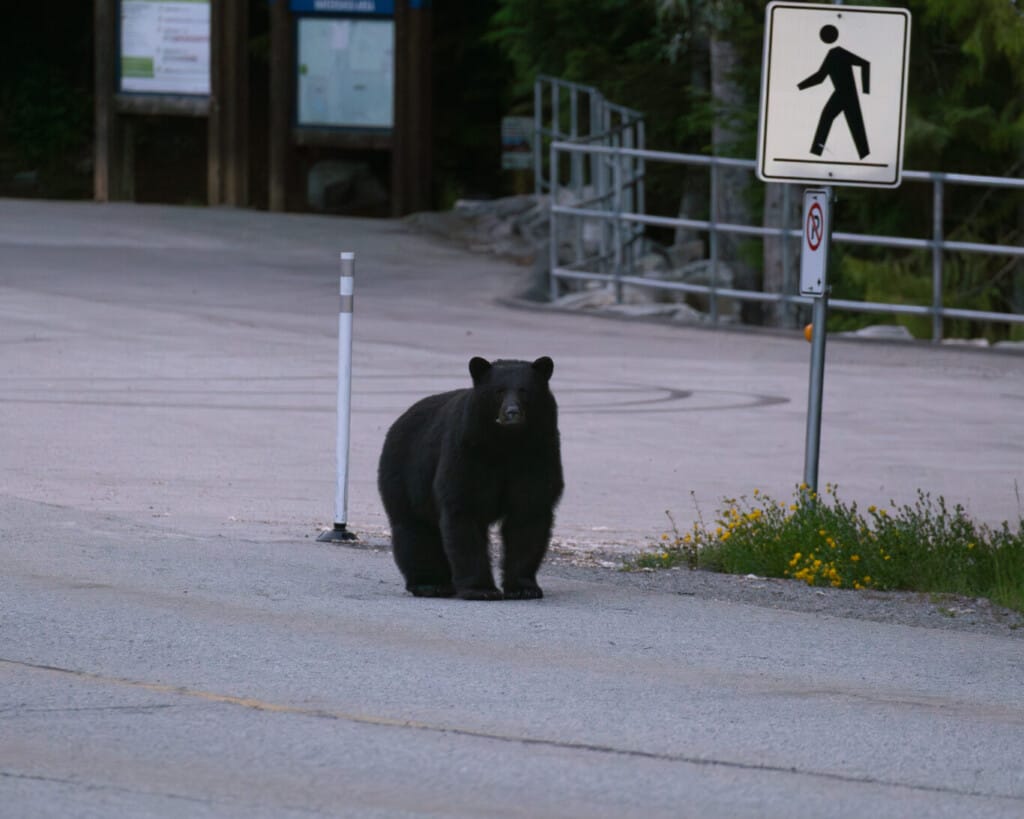
Every spring in Whistler, familiar faces return. It is not a coincidence that the same bears return to the same spots year after year.
These sightings may feel random to us, but for bears, they are anything but. Bears use the Whistler valley and trail system strategically, returning annually to the same feeding areas, travel corridors, and resting sites.
Once a food source, always a food source
If a bear obtains food from a specific location, it will remember that site forever. A mother bear will even pass on her knowledge to the next generation, showing her cubs the site.
Bears’ memory is so good that if it obtains a food reward from, say, a home construction site, it will return to that home even after the building is fully built and occupied. To the bear, the site becomes part of its mental food map.
This is why it is so important for residents, businesses, workers, and visitors to properly secure garbage, food, and scented items. A single food reward can alter bear behaviour for years.
Bears follow a seasonal food calendar
Bears move through Whistler according to an annual food calendar. Their movements are closely tied to what foods are available each season.
Spring
After emerging from winter hibernation, bears search for early-season vegetation that is not covered in snow, such as:
- dandelions
- grasses
- skunk cabbage
- horsetails
Bears have learned that golf courses often offer easy access to dandelions and snow-free grass in the early spring, which is why many return to the same courses every year. Stay alert when walking on local golf courses and check out these handy tips to stay safe.
Summer
As the snow melts in the mountains, bears commonly look for:
- berry patches
- alpine vegetation
- riparian zones interfacing between land and a river or stream
Following their internal food map, bears are known to frequent the same trails every year.
Fall
Before denning, bears enter a stage called hyperphagia, an intense feeding period where they consume as many calories as they can in preparation for winter hibernation.
During this time, bears will commonly seek out:
- alpine berry patches
- residential neighborhoods *It is especially important to not leave pumpkins out in fall as they will attract bears
During hyperphagia, a black bear may require 20,000 calories per day. Again, as bears are constantly searching for food, it is important to keep all scented items secure.
Bears are quick learners
Like most young mammals, cubs learn a lot from their mom. Sows will teach their cubs things like:
- safe travel routes
- feeding locations
- resting areas
- how to navigate around humans and dominant males
Because bears are such quick learners, obtaining a human food reward has the potential to not only impact a single bear, but multiple generations of the same family. That’s why it is so important to keep attractants and food sources secure and away from all bears — the old and the young.
Bears are also highly adaptable. Over time, mature bears establish home ranges and movement patterns across Whistler. Some have learned to move through neighbourhoods and trails during quieter hours of the day to avoid people while still accessing important habitat — so no matter what time of day or night it is, be prepared and stay bear aware.
Living alongside wildlife
Bears have called Whistler home long before it became a global ski destination. Bears are not simply passing through. Bears use historic trail corridors and follow seasonal food routes that were established well before the arrival of roads, neighborhoods, and chairlifts.
The choices we make daily directly influence how safely bears can continue living in Whistler.
Simple actions make a major difference:
- secure garbage and recycling
- never feed wildlife
- keep vehicles and construction sites free of scented items and attractants
- respect trail closures and wildlife signage
- give bears plenty of space, at least 100 metres
- walk dogs on a leash
- when possible, remove food items from vehicles and always keep your vehicle locked with the windows up