
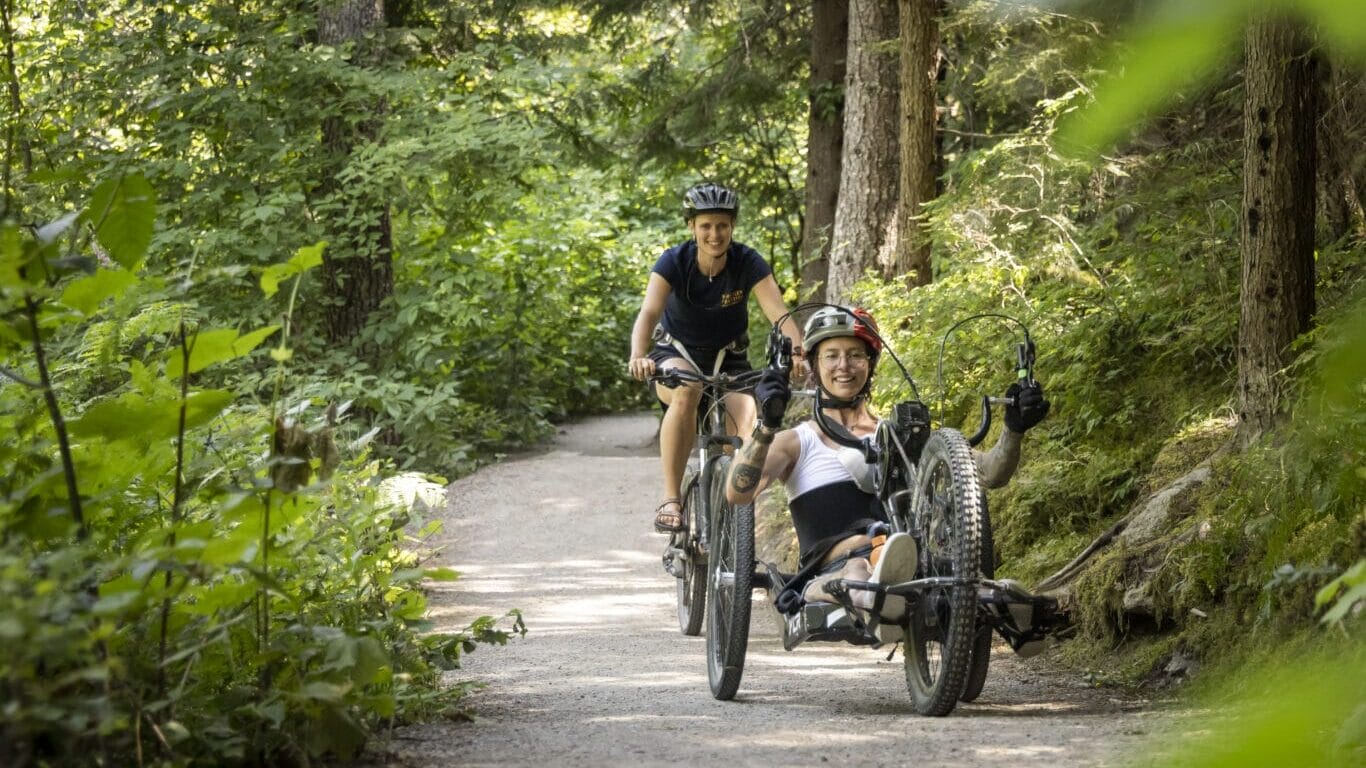
Goal: By 2030, 50 per cent of all trips within Whistler are by transit and active transport such as walking, biking and e-biking.
Getting around Whistler without a car is good for your health, your wallet, and the planet. Presently, personal vehicles and commercial fleets account for over half of Whistler’s total Greenhouse Gas emissions. Big Move 1 focuses on making it easier and more enjoyable to walk, bike, roll, or take transit, so we can cut emissions and keep our community moving, sustainably.
What we’re doing
Public transit
- Increase ridership by keeping fares affordable.
- Enable shorter trip times with infrastructure improvements like dedicated transit merge (queue jumper), transit acceleration lanes and/or dedicated transit lanes.
- Improve accessibility, inclusiveness and overall travel experience.
- Improve transit stop infrastructure, adding more benches, shelters and accessible features.
- Engage with provincial government and neighboring community partners to increase regional transit between Whistler and neighbours.
Active transport (wheeling or walking)
- Prioritize active transport infrastructure by closing gaps in the Valley Trail network, creating protected bike lanes, and enhancing the quality of the network with lighting.
- Encouraging the use of e-bikes as a transportation method, while maintaining the safety of all active people.
Land use considerations
- Incentivize the development of compact neighbourhoods and transit nodes.
- Ensure new developments are connected to transit and active transport infrastructure like the Valley Trail.
Small actions you can take
- Start by walking, biking, or rolling instead of driving once a week. Build from there.
- Hop on the bus to your next festival, errand, or night out.
Did you know?
- Switching a 10 km daily commute from a single passenger vehicle to transit can reduce your carbon emissions footprint by 0.7 metric tonnes.
- An e-bike produces roughly 1/6,000 the GHG emissions of a car. If you commute to work on an e-bike 200 days a year for 30 years, you’ll emit the same GHG as driving your car for just one day.
RMOW divisions and key partners
Lead: Climate and Environment
Support: Parks Planning Planning, Infrastructure Services (Roads)
Partnerships: Climate Action and Environment Committee, BC Government, Municipalities within the Sea to Sky Corridor, BC Transit, Translink, Ministry of Transportation and Transit (MOTT)